

14In a previous reflection, we explored the practitioner’s journey through the allegory of the rough stone, coming to be polished tirelessly on the tatami mats to strive toward the perfect sphere. But an essential question arises: what is the true tool used for this polishing? By what force does the stone finally lose its rough edges? The answer lies neither in innate talent nor in exceptional physical strength, but in two fundamental virtues of the martial path: commitment and consistency. It is precisely on this point that the absolute dividing line between a traditional dojo and a contemporary sports club is drawn.
The Practitioner vs. The Consumer
Our era is marked by a culture of consumption and immediacy. When enrolling in a fitness club or a gym, the approach is often transactional: one pays to access a service, machines, or classes that are “consumed” according to one’s desires, motivation, or schedule. If you don’t show up for a month, the weight machine doesn’t care, and the gym keeps running. The individual there is a client.
Walking through the doors of a Shorin Ryu Karate and Kobudo dojo follows a radically different paradigm. A dojo does not offer a service; it offers a path.
By committing to Oshukai Reims Champagne, the individual ceases to be a consumer and becomes a practitioner (Shugyosha). They do not simply pay to “do sports”; they commit to an art, to a teacher, and above all, to the group and to themselves.
Consistency as a Tool for Inner Polishing
Let us return to our polishing stone. In nature, it is the regularity of the waves and the constant friction of the sand that transform a rock into a smooth pebble. On the tatami, this friction is called consistency.
-
The illusion of motivation: Coming to train only when you are in great shape and highly motivated is easy. It polishes the surface, but it does not transform the structure.
-
The strength of discipline: Coming to the dojo on winter evenings when the day’s fatigue sets in, when motivation wavers—that is the exact moment when true martial work begins. It is within this voluntary constraint that the ego fades, the mind is forged, and the spirit is refined.
The pure technique of Karate and Kobudo is not revealed in sudden flashes of brilliance. It is infused through the repetition of Katas and the regularity of Kihon, week after week, year after year. Without this consistency, the stone retains its blind spots.
A Collective Commitment: Growing Together
Commitment in a dojo extends beyond the individual sphere. Unlike the dumbbells in a gym, our “tools” for progression are alive: they are our training partners.
Martial practice is an ecosystem where everyone is responsible for each other’s evolution. The consistent practitioner gives their partners the opportunity to practice against genuine attacks, precise blocks, and constant energy. Consistency thus becomes a mark of respect. Not attending regularly means depriving oneself of progression, but it also deprives the group of one’s own energy. The renewal and vitality of the school rely on this shared presence.
The Silent Promise of the Karategi
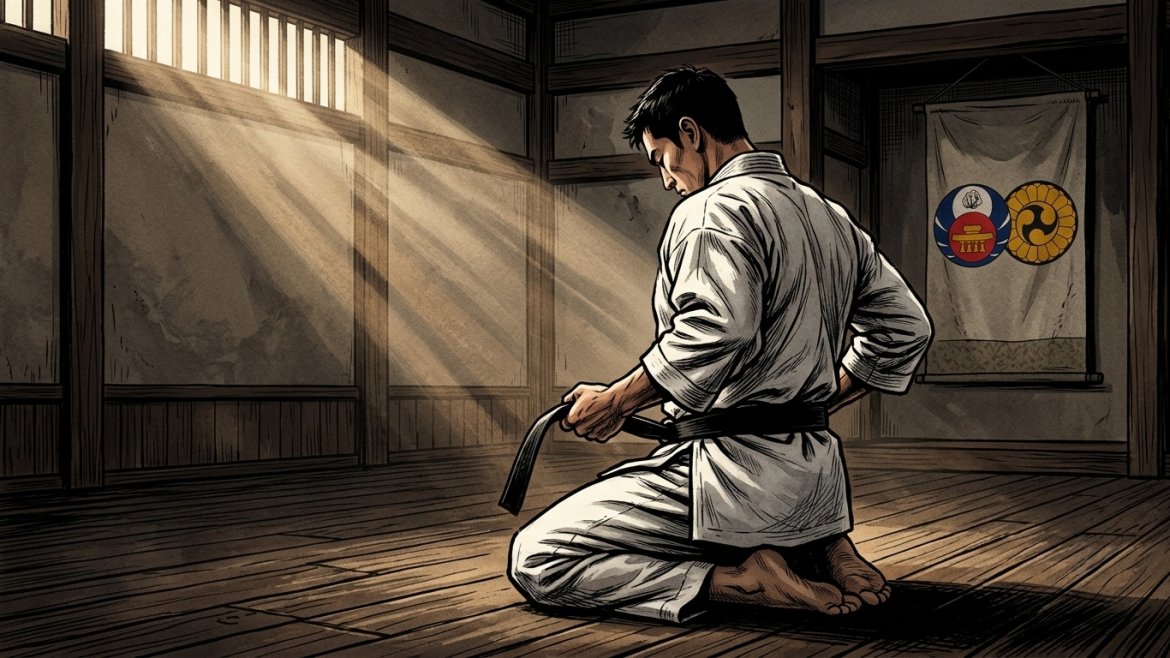
Putting on one’s karategi and tying one’s belt is not simply putting on sportswear. It is renewing, at every class, a silent promise: that of being present, being involved, and striving to be better than yesterday, both technically and humanly.
The dojo is a space outside of time and the consumerist logic of our society. It is a place of benevolent rigor where commitment is not seen as a burden, but as the only true vehicle capable of leading us from the rough stone to the accomplished sphere. The path is laid out; it is up to us to walk it with constancy.